
What Goes Under Artificial Turf? Base Materials Explained for Northwest Installations
Content Blocks
WHAT GETS REMOVED FIRST
Before any base material goes down, the existing surface has to come out. For most residential lawns this means removing sod, organic topsoil, and roots down to stable subgrade. Typically 3 to 4 inches of material gets excavated and hauled away by our team of artificial grass installers. We use a combination of either mini skid steer, excavator or sod cutter when necessary.
Organic material left beneath a turf installation breaks down over time, causing the surface to sink unevenly and creating conditions where bacteria and odors accumulate. Clean excavation down to stable native soil is the starting point everything else depends on. If the yard has an existing irrigation system, sprinkler heads get capped during this phase. Underground utilities are marked before any digging starts.

LANDSCAPE FABRIC FOR SOIL SEPARATION
On most projects (not all) and before base rock goes in, a layer of non-woven landscape fabric goes down directly on the compacted subgrade. We use a 3-ounce non-woven geotextile, which functions as a soil separator rather than just a weed barrier.
The distinction matters. A soil separator prevents native soil from migrating up into the aggregate base over time, which would degrade drainage performance and cause base settlement. Water passes through freely in both directions, so it does not impede drainage.

THE BASE LAYER: AGGREGATE AND DEPTH
Once the fabric is down, crushed aggregate base goes in. For residential lawn and pet turf installations in the Pacific Northwest, we install 4 to 6 inches of compacted crushed rock. The exact depth depends on what we find when we excavate.
In the Puget Sound area, 5/8 minus crushed rock is the most common base material for artificial turf installations. Some projects use 3/4 minus depending on site conditions and drainage requirements. Both are angular crushed aggregate that compact well and provide the drainage pathway water needs to move off the surface efficiently.
Crushed rock base does several things simultaneously. It creates a stable, level platform for the turf. It provides the drainage channel that moves water down through the profile and into the soil below. And when properly compacted, it prevents the turf from shifting, wrinkling, or developing low spots under foot traffic over time.

COMPACTION: HOW IT GETS DONE
Loose aggregate base is not a finished base. After rock is spread and graded, it gets compacted. We use plate compactors for most residential jobs and double drum rollers on larger installations and putting greens where a finer, truer surface is required.
Compaction happens in lifts. Rock is added in layers and compacted progressively rather than all at once. This ensures consistent density through the full depth of the base rather than a hard crust over loose material below.
Properly compacted base is what prevents the surface from settling unevenly over years of use. A base that was not compacted in lifts will compress gradually under foot traffic and equipment, causing ripples and low spots in the turf above it.

NORTHWEST DRAINAGE REQUIREMENTS
The Puget Sound area receives 38 or more inches of rain annually, concentrated heavily between October and April. That volume of water has to move through the turf system efficiently or problems accumulate quickly.
This is where Pacific Northwest installations differ from what national guides describe. Drainage is not a secondary consideration here. It is the central engineering challenge of the installation. Every base we build is graded to direct water away from structures and toward areas where it can infiltrate the native soil. Flat or improperly graded base leads to pooling, odor, and over time, base failure.
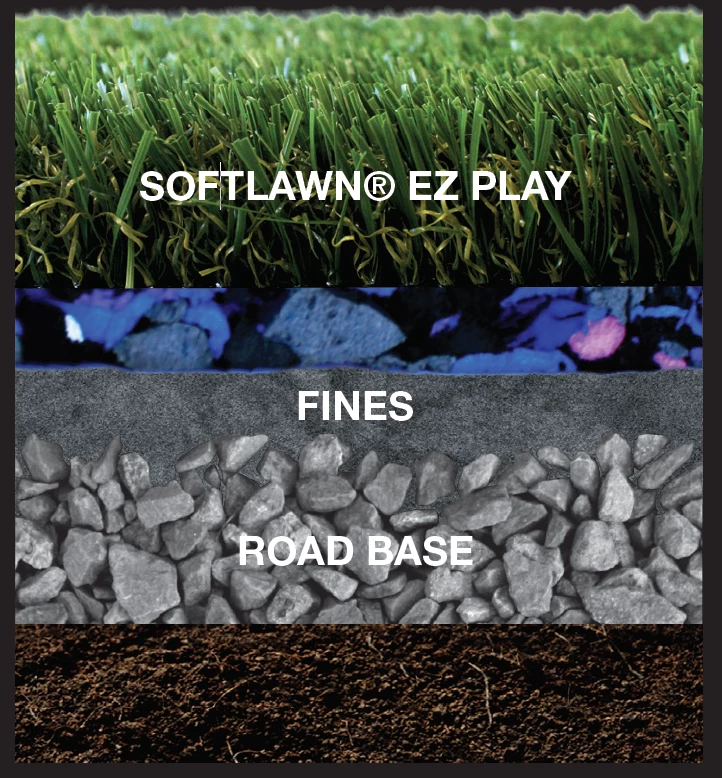
PET TURF BASE: CLEAN ROCK PLUS MINUS
Pet turf uses a layered base system that differs from standard lawn installation. The bottom layer is clean drain rock, washed angular aggregate with the fine particles removed. Clean rock maintains open void space through the full depth of the base so liquid can move through the profile efficiently under sustained daily pet use. Standard 5/8 minus contains fine particles that compact progressively over time and gradually restrict drainage. For a yard with dogs using it every day, that matters.
Over the clean rock we add a layer of 5/8 minus. This provides the compaction and surface stability that clean rock alone cannot achieve. The result is a base that drains like clean rock but compacts and performs like a properly built aggregate base.
This layered system is specific to pet installations. Standard lawns use 5/8 minus throughout. Pet installs use clean rock below, minus on top, for drainage performance and structural stability together.
PUTTING GREEN BASE: A DIFFERENT SPEC ENTIRELY
Backyard putting greens use a fundamentally different base specification than lawn or pet installations.
We build putting greens with 1/4 minus crushed material, a finer aggregate than what goes under lawn installations. The fine gradation is what allows it to be shaped, contoured, and compacted to a smooth, precise surface. Total base depth on a putting green is typically 8 to 12 inches, and on more complex builds with significant contouring or mounding it can exceed a foot.

Why so much base? Because the contouring is built into the base layer, not the turf. The slopes, breaks, and elevation changes that make a putting green play realistically are engineered below the surface and the turf follows the shape the base creates. Getting that shape right requires depth and compaction precision at every stage of the build. We use double drum rollers on putting green bases specifically because the surface they produce is truer and more consistent than what a plate compactor achieves on 1/4 minus.
INSTALLING OVER EXISTING CONCRETE
Not every turf install starts with excavation. When turf goes over an existing concrete slab, a patio, a dog run, or a commercial floor, the existing surface becomes the base.
In these situations we install Air Drain Geocell directly over the concrete before the turf goes down. Air Drain Geocell is a three-dimensional drainage mat that creates an elevated, ventilated layer between the concrete and the turf backing. Liquid passes through the turf, through the geocell, and drains out at the perimeter.
Concrete installs are often simpler and faster than ground-up installs. There is no excavation, no base rock delivery, and no compaction work. The geocell layer handles drainage differently but achieves a comparable result, and the absence of excavation cost often offsets the geocell material cost.
COMMON QUESTIONS ABOUT ARTIFICIAL TURF BASE MATERIALS
Does artificial turf need a base? Yes. Turf installed directly on native soil without a prepared base will not drain properly, will shift under foot traffic, and will develop an uneven surface within a few years. The base is what makes the installation perform and last.
How deep should the base be for artificial turf? For residential lawn and pet turf in the Pacific Northwest, 4 to 6 inches of compacted crushed rock is standard. Putting greens require significantly more, typically 8 to 12 inches or deeper depending on contouring. Properties with clay-heavy soil or drainage problems may require additional depth.
What type of crushed rock is used under artificial turf? In the Puget Sound area, 5/8 minus is the most common base material for artificial turf installations, with 3/4 minus used on some projects. Pet turf installations use a layered system with clean drain rock on the bottom for drainage and 5/8 minus on top for compaction and stability.
Can artificial turf be installed over concrete? Yes. Turf installed over an existing concrete slab uses Air Drain Geocell as a drainage layer in place of crushed rock base. This eliminates excavation and results in a simpler, faster installation.
How does Pacific Northwest rainfall affect artificial turf base requirements? The Puget Sound area receives 38 or more inches of rain annually, concentrated from October through April. This places significantly more demand on base drainage than most climates. Proper grading, adequate depth, and correct aggregate selection are critical here in ways they are not in drier markets.